April 27, 2023

Mario Boone Sale 70, the 40th Anniversary Sale


I just received Mario Boone's huge, 360-page full-color catalog for his auction, number 70 he will hold in Antwerp May 6 and 7, 2023. For the last forty years, Mario and his father Erik before him have been selling certificates from most countries across the globe. This catalog continues that tradition and I count about 140 lots related to railroads in North America plus a few coal companies. 

I wanted to get notice out as quickly as possible, so have not had time to look closely at every lot, so let me hit the highlights.

The auction is divided into two parts, live and internet. The live auction sale contains the lion's share of scarce and rare certificates. Those items will cross the block May 6 and 7. The internet auction for the remained will take place on Invaluable.com on May 8 and 9. 

Roughly half of the North American certificates are rarities and scarcities that are rarely seen for sale on either side of the Atlantic. Many of those are arguably unique. With the exception of one-of-a-kind proofs, I don't call any certificate "unique" because I do not know what hundreds or thousands of collectors may have hidden in their basements. But I can tell you, there are many items in this sale that I have only seen offered once.

Lot 687 is a March, 1832 (joint) stock certificate of the Delaware & Raritan Canal Co and the Camden & Amboy Railroad & Transportation Co. This was one of the earliest operations we can legitimately call a railroad, and this certificate was issued about six and half months before the line officially opened for traffic. It was issued to Robert Stevens and signed by Edwin Stevens as treasurer. (The certificate was cancelled with two pen marks and neither touch the signature.)

Another very early item, by California standards, is a $1,000 bond of the California Central Rail Road. This bond (#108) appears as lot 694 and is one of only two examples known to me. To my knowledge, this item was last sold by Scott Winslow in 1995 and has been hiding out in Germany since. Another example later appeared in Germany nine years ago.

Although issued three years after the previous bond, a very rare stock certificate from the Sacramento Valley Rail Road will be offered as lot 697. That company was incorporated in 1852 in California and ultimately became part of the Central Pacific in 1865.

Scarcer is lot 690 from the Chicago St Paul & Fond du Lac Railroad, dated1855. Its design is quintessential of certificates engraved by Wellstood Hay & Whiting. I have recorded only one occurrence of this variety of stock certificate offered in lot 690. I cannot find any record of other appearances before this item sold in a Fred Holabird auction in 2020.

Another serious rarity is an 1877 stock certificate from the Ralston Rail Road & Coal Co from here in Colorado. Ralston Creek was one of the first drainages prospected for gold by men heading to the California Gold Rush. They found only hints of gold there, but coal was later discovered at the base of the foothills and a railroad was planned to enable extraction. Mario is offering certificate #11, the only example I have encountered. It last sold in Germany in 2014.

Boone is also offering another equally rare stock certificate (lot 708) from the Alabama & Chattanooga Rail Road, dated 1871. I last encountered this single certificate (#41) in a 1997 Smythe sale.

Old Union Pacific Railway stock certificates are essentially unknown except in proof form. Lot 722 is a 50-share proof by American Bank Note Co and was dated 1881 in crayon pencil. These come up for sale only rarely and they are highly sought after.

To save the best for last, I purposely skipped over eight lots (678 to 685) of Gould-signed certificates from seven different companies. We're not talking about the well-known and ever-popular items from the Missouri Kansas & Texas Railway. Gould's signature on seven of the eight lots are terribly hard to find and thus have starting prices in excess of 2,000 Euros. The standout, at a €12,000 minimum bid, is Gould's signature on an uncancelled $1,000 bond of the New Jersey Southern Railroad Company. Even the custom vignette on this bond is a keeper. I recorded this potentially unique bond from a Smythe sale in 1992 and it has been hiding somewhere for the last thirty-one years.

At more affordable levels are certificates from the second half of the sale offered to be over the internet on Invaluable.com. Most of those lots have starting bids in the range of €80 to €200, with a few cheaper and a few more expensive. While none are in the collectibility class of the live auction items, there are several notable scarcities waiting to be acquired by discerning intermediate to advanced collectors.

As always, I suggest two things. First, don't dawdle. Try to acquire a physical catalog while they are still available. At 360 pages, this is the largest Boone sale ever. Start by going to Booneshares.com.

The second thing I recommend is viewing items on Boone's site, even if you're going to bid on Invaluable. Mario has a new website design and his online catalog displays 100 items per page. Click on any item for a full description, and once there, click again on images to see scans larger than any of his competitors. 

Again, please don't dawdle.


October 20, 2022

Mario Boone auction 69


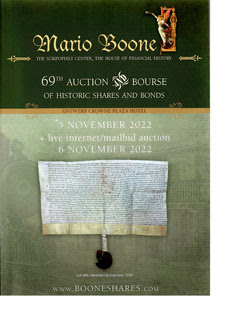
 Mario Boone's 69th Auction and Bourse will take place at the Antwerp Crowne Plaza Hotel on November 5, followed by and internet/mailbid auction the following day. You may view lots large scale images 1) online at Booneshares.com, 2) in the physical full-color catalog or 3) on Invaluable.com. I want to make collectors aware of this sale because it will offer 163 lots, the largest Boone selection of rail-related certificates from North America since 2008. In fact, only two sales have ever had more such certificates offered.

The are so many lots in this sale that it is hard to narrow the selection for review here. There are numerous items that I have not seen in ten or fifteen years, with some even further back. Let's start with an unissued stock certificate from the Erie Railway Co. (Lot 570.) The last time I encountered this certificate was in Smythe sale 14 (lot 3034). It is an unissued, but cancelled certificate printed by Henry Seibert & Brothers Co. Smythe noted the item was used by ABN as a model for later issues. It fetched $744 in that sale including commission. To my knowledge, no other examples have appeared in thirty years.

An 1872 second mortgage bond from the Cayuga Lake Rail Road Co. (Lot 567, serial 34) is one of only two examples known to me.

Lot 603 is a proof of a certificate of deposit from the Central Pacific Railroad Co. of California for Extended Mortgage bonds deposited with Speyer & Company. It is printed on thick paper with no printed border. There is no printer name, but the vignette is one that was used frequently heavily by American Bank Note Co., so I strongly suspect this item is of ABN origin and is probably unique.

An example of a stock certificate from the Twin City & Lake Superior Railway Co. appeared on the cover of the first edition of my catalog. I don't know where that image came from, but I have never encountered any of these in person. In fact, I have cataloged only four unissued and six issued (and uncancelled) examples ever. Lot 613 is serial #273.

Another interesting certificate is a stock from The Alton & Upper Alton Horse Railway & Carrying Co. (Lot 562.) It has somewhat of an odd name, but is otherwise not terribly outstanding as far as horse railroads go. This item is serial #15 and last appeared (to my knowledge) in Smythe sale 242 in 2004. Like the above certificate, this lot makes a total of six serial numbers recorded, but it has historically fetched high-than normal bids (median = $185.) 

Lot 559 is an offer of a Troy Salem & Rutland Rail Road Co. certificate signed by Jay Gould as president. At a €200 start price, this would almost seem like a giveaway for a previously unrecorded Gould-signed item. (I had heard of one like this before, but did not have sufficient particulars for listing.) I have recorded only two other issued serial numbers (#3 and #73), so this one (#2) is new. I think Mario's low start price reflects that this issued certificate, like the other two, is heavily pen cancelled through officers' signatures. Nonetheless, it may be a LONG wait before another example with Gould's signature appears.

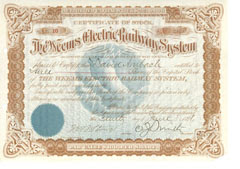
I first saw serial #10 of the Weems Electric Railway System in 2002 from a copy sent by one of my earliest contributors. It later appeared in an FHW sale ten years later and is now offered by Mario Boone another ten years further on. It remains the only example I have learned of. Please look at a picture of Lot 598 to see the large blue underprint that sets it apart from almost all other stock certificates.

In addition to certificates from the United States are numerous rarities from elsewhere in North America including Barbados, Jamaica, Bermuda, Cuba and elsewhere. Like I said at the start, there are just so many, I cannot do the sale justice. You will need to view for yourself. And if the ones I mentioned seem above your normal price point, please see for yourself. There are many affordable scarcities, too numerous to mention.

April 13, 2022

Mario Boone 68th Auction and Bourse


Many of you have probably already received Mario Boone's latest auction catalog – number 68, scheduled to take place April 30 and May 1 in Antwerp, Belgium. 

This sale was a real pleasure to review because of the abnormally heavy concentration of stocks and bonds from North American railroads: 126 lot in all.

While Mario usually features rarities and rarely-seen items, he has outdone himself this time. Many items must have lived in old collections because there are several items I have not seen offered for sale in twenty years. A few specific serial numbers last appeared for sale in the early 1980s. I try very hard to avoid using the word "unique" because no one on the planet can possibly know what certificates may be hiding in old collections and dealer inventories. I will, however, say that ten items are possibly unique. Two certificates represent one of only two that I have seen in records going back to 1979. Five items represent companies that are new to me. While new company names are found frequently, they are rarely represented by certificates.

One of the curiosities that caught my attention is an 1869 bond from the Burlington Cedar Raids & Minnesota Railway Co (lot 1116). It is a dual denomination bond ($1,000/£200) probably intended to be sold in both the U.S. and Europe. It is the first certificate known from this company (the one incorporated in both Iowa and Minnesota.) 

The bond was handsigned in three places, apparently in the same hand, over the printed words "cancelled." I could not find a serial number. Instead, I found and engraved inscription in the bottom left corner that says, "Sample Bond." Its true purpose is unknown, but I am listing this item as a specimen because it was clearly not intended for issuance. Except for the three "cancelled" words and the "Sample" inscription, it is a legitimate printing from Henry Seibert & Brothers. This bond issuance is definitely referenced in the 1870-1871 Poor's Manual, although under the incorrect listing of "Railroad." 


Another highly interesting item is an 1872 $500 bond from the New Egypt & Farmingdale Rail Road (lot 1124). Not only is the bond the first and only certificate recorded for this company, it is also uncancelled and signed by Jay Gould as president of the New Jersey Southern, the guarantor of the bond. European collectors are especially fond of celebrity autographs, so I expect this item to attract bold bids.

I had known of the Choctaw Coal & Railway Co. since the mid-1990s and I had found reference to its bonds being foreclosed in 1894. However, This lot 1157 is the first time I have seen any of those bonds offered as collectibles. I warn collectors that if this bond is not unique, it is nearly so. The bond was engraved by New York Banknote Co., probably in 1889. It shows two vignettes; one of miners filling mine cars behind a mule and another of a fireman stoking a locomotive boiler. Both these vignettes appeared on bonds of the Columbus Shawnee & Hocking Railway Co., known for possibly the most fanciful vignette on railroad certificates. Bonds of both companies were issued Jan. 1, 1890.

Another item I want to bring to the attention of collectors is lot 1150 featuring a serial numbered specimen bond of the Central Railroad of New Jersey. Only a tiny number of issued bonds of this variety are known and have historically sold for around $700 apiece. This is the first one I have encountered in specimen form and the starting price is offered for about half that amount. My records suggest there have not been many opportunities to bid on this variety.

Among the many other scarce and rare certificates is a bond from The Northern Pacific Terminal Company of Oregon (lot 1142) featuring the typical N.P. image of Mount hood. The starting bid is €200, a price the belies the fact that I have not encountered any public sales of this variety since 2001. I am not saying there are not more examples out there; I'm saying that they are going to be hard to find.

There are many, many more examples of items I would like to have time and space describe, but I suggest you check for yourself. If you do not already receive Mario Boone's auction catalogs, then go online at https://www.booneshares.com/Home.aspx and check out all the certificates offered in this sale as soon as possible. Bidding is conducted in person, by mail or via the internet on Invaluable.com. Commissions are 17% for low-priced items (€100 and below and only 10% for sales above that value. VAT applies to European buyers and 3% is added to successful bids made through Invaluable.

Really. If you're a serious collector, you need to check out this sale.


October 15, 2021

Mario Boone Auction 67 - Short notice


Mario Boone's (longtime dealer and auctioneer headquartered in Belgium) next sale will take place October 16 and 17 in Antwerp. Unfortunately, I did not receive his catalog until October 14, so I apologize to him and my readers that I did not get a chance to review sooner.

Unlike his last few sales, this one has a great selection of mid-grade railroad (77 items) and coal (7) certificates. I just checked every item offered and found that 80% of his advertised lots have minimum bids BELOW my price estimates. All but one of the remaining lots are priced reasonably above my estimates, well within the amounts European bidders are familiar with. And that includes commissions and VAT. (But not ever-shifting Euro-dollar exchange rates.

I unfortunately do not have time to describe lots except to say that if collectors are scared of bidding in Europe, they are going to miss many certificates that they do not see in the U.S. with any frequency. Moreover, they need to consider that European and American bidders tend to focus on different kinds of certificates. To be sure, American bidders will encounter competition, but large numbers of recent sales have taken place at starting bids. 

Be aware that only a handful of certificates being offered in sale 67 are ever seen on eBay. I don't have time to do a deeper dive, but it looks like the majority of these certificates appear for sale with a frequency in the range of once every three to ten years.

Think European sales are always expensive? Think again. 77 of the 84 lots have starting prices of $100 or less. Moreover, 56 of the 84 have minimum bids of $50 or less. Remember, I am counting both commission and VAT.

If you want a few to look at quickly, I will suggest lots 1164, 1243, 1332, 1338, 1343 and 1357. Collectors of coal mining certificates should peruse lots 1258 and (especially) 1288.

Oh yes, I forgot. Six items are new to me.

Again, I apologize for not being able to review this important sale earlier, but mail from Europe has been taking an unusually long time to reach me. If political news is anywhere near accurate, those times are only going to elongate.


March 31, 2021

Time for another Boone auction!


In only a few days, Mario Boone will be kicking off his 66th auction. Because of the ongoing coronavirus threat, bidding will be a combination of mail bidding and online bidding through the Invaluable.com platform. Please check out listings and images on the Booneshares.com website as soon as possible. Then, if interested, fax or email your bids by April 9th or make sure you are registered with Invaluable.

In this auction, you will find 34 certificates from North American railroads plus 7 from coal companies. There are standouts in both categories, so I will mention a few.

Perhaps the most important is Compañia de Caminos de Hierro de la Habana (lot 847) from Cuba. It is a 1-share dated 1853. I recorded this sole certificate from a 2003 Boone sale, but Mario says he knows of three. It last sold for the equivalent of $1,967 and if it reaches the minimum asking price will beat that earlier sale slightly. I know of only two or three earlier railroad certificates from Cuba.

Entirely new to me is an 1872 bond from Sociedad Anónima de los Ferro-Carriles del Salvador (lot 850.) I don't know how many El Salvador collectors there might be, but I'm pretty sure they are not going to see another one of these certificates for a long while.

There aren't many coal mining collectors are out there, but a 20-share certificate from the Mount Carbon Coal & Iron Company is most assuredly worth looking at. That is, if you want to see a stock certificate with a vignette all the way across the top and down the left side.

Lot 958 is a stock certificate from the American Rail-Way Manufacturing Company featuring an unusual monorail. I know of only four like it.

An issued bond from The Duluth Street Railway Company is offered in lot 1020 and represents one of only two issued examples I've encountered. (There is also at least one specimen. The next lot (lot 1021) is a stock certificate and perennial favorite from the Weir Frog Company featuring six vignettes of its hardware in red underprint.

I think railroad collectors will be checking out the ones I've mentioned, but there are six that I bet a LOT of collectors are going to overlook. They are bonds from the New York Central and the New York New Haven & Hartford Railroads. All LOOK familiar, but only because everyone has seen the vignettes on many other railroad bonds. In truth, the $1,000, $5,000 and $10,000 registered bonds from the NYC are each represented currently by 2, 12 and 4 examples respectively. (See lots 1028, 1029 and 1030.) I would never say there aren't more extant; I'm just saying I've never seen them.

The NYNH&N bonds (lots 1034, 1035 and 1036) are also registered bonds denominated as $1,000, $5,000 and $10,000 and are also easy to overlook. If someone knows of more out there, then please tell me, because I've only recorded 1, 1 and 4 issued examples respectively. 

Please examine the full listing of 1,117 lots at Booneshares.com and please do it quickly because the sale will take place April 10, 2021.


March 20, 2021

Fifty. No, twenty. No, Fifty


This reminds me of one of those ink spots that looks like a dog at first and then like a World War I tank a few seconds later.

A curious handwritten denomination on a Burlington, Cedar Rapids & Northern Railway Company certificate from 1879. that first looked like a fifty-share, then a twenty and then a fifty.

Images courtesy Dr. Thomas O'Shaughnessy.


November 13, 2020

Origin of the word "Scripophily"


In case you missed it, I transcribed the following from the "Business Diary" section of the Times (of London), May 9, 1978, page 25.

Business Diary: Scripophily: is our word your bond?

Ross Davies, Business Diary's Editor, reports on the outcome of Business Diary's name-the-hobby competitions.

The winner of our competition to find a name for the hobby of collecting old bonds and share certificates is Arthur Howell, of Brighton.

He suggested "scripophily," a word effectively half-English and half-Greek, combining scrip (a provisional certificate as for shares, share certificates, or shares or stock collectively – an abbreviation from subscription receipt) with philein (to love).

He wins a price of £10-worth of bonds offered by the originator of the competition, Commander Donald Ross. The Commander is a keen collector and is secretary of the Vintners' Company.

Howell will also receive a collection valued at £100 from Colin Narbeth, a joint managing director of dealers Stanley Gibbons Currency Limited. They weighed in with this offer on reading of the competition in the Business Diary.

The winner will receive his prizes at a luncheon in his honour which Gibbons is throwing in London on Monday week.

Left to his own devices, Howell would probably lose little sleep if he never saw a bond or a share certificate again. He is a retired solicitor who spent much of his life handling clients' and it has not left him much of a "phile" – he neither collects the things nor is a habitual competition entrant.

Howell oh-so-narrowly beat Mrs. J. J. Santilhana of Bristol, who pulled up the same roots but suggested using them in reverse order as in "philoscripy".

Commander Ross and I sat down to puzzle through the postcards and came to a gratifyingly quick and painless agreement. We reconsidered over a bottle of Château Malescot St. Exupery Margeaux 1971, but remained unshaken in our resolve. Howell and scripophily it was.

The commander had his way of reaching a conclusion and I mine. He had chosen four criteria, each carrying five marks.

One criterion was whether or not the word conveyed the sense of bonds or certificates and, if possible, deadness. The chosen word would also have to signify love of collection; it had to convey a picture and, lastly, it had to come trippingly off the tongue.

My choice, thank heaven, the same a my companion's, was made because it seemed a good idea at the time.

Mrs. Santilhana and her philoscripy, we decided, had to give way to Howell and his scripophily, as the latter was just that much easier to say. I do hope Mrs. Santilhana will not stop reading the Business Diary.

She, I trust, will reflect that the commander and I had also seen our suggestions bettered. Some weeks ago I had suggested "bondaphily" in print whereupon the commander wrote in to say that my choice "smack of cheese" and then offered to fund a competition to thrash out the matter.

Postcards, some covered in entries, came in from England, Scotland and Wales. There was even a delightful view of Lulworth Cove, which came to us from R. G. Holloway in Brussels of all places. He suggested "bonditry."

Perhaps the most elegant entry , again a multiple one, came from Bernard Slater, the senior classics master at Bradford Grammar School. I quite liked his "promissophily", but found his "syngraphophily" and "philosyngraphy" a little chewy.

Mrs. D. Bryden of Melrose, Roxburghshire, enlisted Shakespeare, quoting thus: "I'll have my bond; speak not against my bond. I have sworn an oath that I will have my bond."

What else could she then suggest but "Shyloxsis"? Mmm, thought the commander and I, we'll let you know.

Stanley Gibbons Currency Limited, which is to hold a first British auction of bonds and share certificates in November, declares our choice of scripophily "most apt." Robin Hendy, its advisor, has already been rechristened "scripophilic expert."

Yesterday I spoke to Mr. Robert Burchfield, the editor of Oxford English Dictionaries. He says that Howell's word could be in volume three of the supplement to the OED which is to appear in two years' time.

Commander Ross, meanwhile, plans to start a scripophiles' club: we will give the address to write to shortly.

Webster Dictionaries
[Terry Cox note:  For those of us who spent three long years in Mrs. Lanham's Latin class, I suspect the word scrip needs a bit more explanation. It certainly goes back further than "subscription receipt." 

According to the esteemed Noah Webster, LL.D., in the George and Charles Merriam's 1852 edition of An American Dictionary of the English Language, scrip comes from the Latin noun, scriptum, the perfect passive participle of scrībō (“to write”). Part of 1852's definition explained A certificate of stock subscribed to a bank or other company, or of a share of other joint property, is called in America a scrip. 

The latest edition of Merriam Webster's Collegiate Dictionary carries the essential parts of that earlier definition and etymology and suggests the first use of "scrip" in this context appeared in 1590.]

October 24, 2020

Mario Boone sale 65 at the end of October


 Unlike most of the recent sales from Mario, North American railroads are under-represented in this sale with only lots in the railroad and coal specialties that I track. Nonetheless, there are a few items I hope collectors will view with an eye for participating in their first non-American auction. Only five items have start prices above 50 Euros. Considering we are currently in an abnormal Fall slump in the market, I think American collectors should have a good chance of bringing several rare certificates back to this continent. 

The first I will mention is a $500 specimen bond of Nova Scotia Steel & Coal Company (lot 1189.) While not everyone's cup of tea, I've always been fond of coal company issuances from Nova Scotia. These are mines accessed coal reserves inland from the Atlantic, but which followed coal seams eastward out under the ocean. I have only encountered this certificate once before in a Boone sale seven years ago.

Another Canadian item is a 1914 $1,000 bond specimen from the Canadian Pacific Railway (lot 1193.) This is only the third example of this bond variety and a new color previously unknown to me. All three examples are recorded only from Europe. Let me remind my American readers that specimens are not currently popular collectibles in Europe. 

Lot 1212 is a another previously unrecorded Bradbury, Wilkinson specimen of a £500 scrip certificate from the  United Railways of the Havana & Regla Warehouses, Ltd. (Cuba.) This rarity has a €50 start price, reflecting the current reality that Cuban certificates are still not collected widely. (And this has always baffled me!)

Surprisingly, another Bradbury, Wilkinson specimen is listed as lot 1245 with the same start price. This rare 1909 certificate represented £100 invested with the London-based Corporation of Foreign Bondholders for the purchase of Republic of Nicaragua bonds dedicated for completion of an unspecified railway from the Great Lake of Nicaragua to the Atlantic Ocean. (I admit this is somewhat oblique to the collecting of railroad certificates, but tell me when another one of these is going to appear.)

A distressed example of an 1839 2-share certificate of the Williams Valley Rail Road & Mining Company is offered in lot 1257. This is one of eight currently recorded and desirable primarily for its 1839 date.

Scarcer is an 1880 stock certificate from the Pennsylvania & Ohio Coal & Mining Co. (lot 1270). from Columbus, Ohio, one of only four currently known to me.

Almost certain to be overlooked by North American collectors is lot 1323, a 1992 specimen fund certificate issued in the Netherlands to hold shares in the Santa Fe Pacific Corporation. This company was a descendent of the Santa Fe Southern Pacific Corp, an aborted attempt to merge the Atchison Topeka & Santa Fe with the Southern Pacific. Dutch fund certificates are rarely seen in the United States, but were highly important in funding many major American rail ventures. (See Slow Train to Paradise: How Dutch investment helped build American railroads for details.)

Unlike Mario's normal sales, this is offered entirely remotely by internet, telephone or advance bidding because of Coronavirus concerns. Please visit Booneshares.com to view all lots and see the rules for bidding. 


March 26, 2020

Boone auction 64, April 4-5, 2020


Like sales elsewhere, Mario Boone's next auction will take place entirely online due to the global coronavirus epidemic. See current auction rules online at Booneshares.com and be sure to register early.

Unlike many of Mario's sales the last few years, the number of North American railroad certificates in sale 64 is somewhat abbreviated, numbering only 18 lots out of 1,653. Nonetheless there are several intriguing certificates.

None of us have a crystal ball to predict how the global coronavirus outbreak will affect participation and prices. My opinion is worth only as much as the next person, which means not much.

I can say one thing for sure, however. Like so many Boone sales before, there are a few items in this sale that are genuinely rare or very scarce. I will not quibble about definitions, but will say with certainty that some of these certificates will not be seen again in the next ten years. Maybe longer. If collectors desire any of these certificates and refuse to bid out of fear of buying in Europe, they better not come crying to me.

Nuff said!

Lot 1570 is a familiar certificate from The Chesapeake Ohio & Southwestern Railroad Co, but this certificate is signed by Collis P. Huntington as president. This lot has a very reasonable start price compared to American sales.

If someone is a fan of the AT&SF, I advise they look at the 1888 certificate of the Rio Grande Mexico & Pacific Railroad Co. issued in the New Mexico Territory (lot 1575.) This certificate was for 69,360 shares issued to the AT&SF and signed by AT&SF president William Barston Strong.

Another rarity can be found in lot 1578, representing an 1891 guaranteed stock certificate from the Richmond Fredericksburg & Potomac Rail Road Co. Mario is offering a low start price on this lot also, even though I have recorded only one other similar certificate in thirty years. Call it anything you want; I'll call it rare.

Lot 1579 is an 1880 $1,000 bond from the Missouri Pacific Railway and features a vignette of its main 4-story terminal building engraved by Homer Lee Bank Note Co. This item is an unnumbered specimen and I suspect was last offered in an R.M. Smythe sale in 2001. While it is impossible to know for certain, I suspect this is one of only two, possibly three, bonds of this design and all are specimens.

The oldest certificate in this Boone sale is an 1832 stock from The New Castle & French Town Turnpike & Rail Road Company (lot 1581.) I have recorded only six similar certificates.

Lot 1584 is the same certificate that last sold in 2012 for $2,277. It is an 1864 Staten Island Rail Road stock certificate signed by Jacob Vanderbilt, both as stock holder and president.

For collectors of rapid transit companies, I recommend Inter-State Rapid Transit Railway Company (Consolidated.) This 1886 certificate is is a $1,000 bond and most observers would instantly confuse this bond with a nearly identical certificate from the Inter-State Consolidated Rapid Transit Railway Co. Notice the slightly different name? I barely did. This is a new-to-me company.

Most certificates in the sale are illustrated in the full-color physical catalog and all certificates are viewable online at Booneshares.com/. Again, be sure to register before the sale date (April 4-5, 2020.)


January 16, 2020

HWPH Auction 54 / 55


Thanks to Herr Matthias Schmitt for sending catalogs for the next HWPH auction which will take place Saturday, January 25 and Monday, January 27 in Wurzburg, Germany.

As usual, the middle part of the Saturday auction (Auktion 54 in this case) is reserved for the fifty of the scarcest and most valuable certificates, all illustrated with articles and larger images in their own special catalog titled 50 Highlights. This time, the cover of 50 Highlights shows Lot 624, a certificate from the New York & Harlem Rail Road Co. This rarity is an 1868 stock certificate issued to and signed by "Commodore" Cornelius. As with the three similar certificates that I can confirm, this shows a "three-generation" association of signatures from the Commodore, son William Henry Vanderbilt (president) and grandson Cornelius Vanderbilt II (counter-signatory.) This is a great-looking certificate with a very clear signature from the Commodore on the back. The start price on this item is €5000, a quarter of the $19,500 price realized in a 1995 Smythe auction for a different serial number. Please be aware that this rarity is among the topmost tier of certificates in the railroad specialty. The last similar certificate sold seventeen years ago.

Elsewhere in Auktion 54 are two certificates signed by J. P. Morgan. Lot 76 is a relatively common New Jersey Junction Railroad bond signed on the back by Morgan and Harris Fahnestock. Much scarcer is Morgan's signature on the back of a Wagner Palace Car stock (lot 79). His signature is barely touched by a single pinhole cancellation. In the same auction is a rare and attractive ABN certificate of Ferrocarriles Unidos de Yucatan (lot 47.)

While neither stocks nor bonds, I also recommend advanced collectors check out lots 72 and 73. The first is an Erie Railway document boldly signed by James Fisk in sending a pass to William H. Birsdsall. The other is a records of dividends disbursed to holders of Hudson River Railroad stocks with three Commodore Vanderbilt signatures.

Auktion 55 has a selection of an additional 47 rail-related certificates, a few with start prices as low as €1. Lot 1797 is a preferred ordinary shares certificate from the Bermuda Railways Investment Co, an item I've seen only a few times. Another certificate that is seen quite infrequently is an 1872 bond from the Chicago & Canada Southern Railway (lot 1813).

Lot 1839 is a Cuba Railroad bond, signed by Sir William van Horne. (As an aside, Cuba railroads certificates are an enticing and historic specialty; I don't know why I don't detect much interest.)

Lot 1920, an 1871 Reconstruction-era bond from the Mobile & Montgomery Railroad, appears favorably-priced and worth a consideration. While I predict most collectors will not pay much attention to an 1869 stock certificate from the Norfolk & Great Western Railroad (lot 1934), they probably should. After all, this is only the fourth certificate to come to my attention in over thirty years!

Auction 55 also contains a section of autographed items, with several rail-related certificates among them. While experienced U.S. dealers have many of these in stock, I have not seen very few offered at auction in recent years. Autographed items tend to be more popular in Germany than in the U.S., so I imagine most or all of these will sell. If interested in U.S. rail-related autographs, you will find items signed by Millard Fillmore (Hudson & Berkshire Rail-Road, lot 2015), James Fargo (Merchants Despatch Transportation Co, lot 2016), Cornelius Vanderbilt II (Michigan Central Railroad, lots 2017 and 2018), Russell Sage (Milwaukee & St Paul Railway, lot 2019), John Dix (Mississippi & Missouri Rail Road, lot 2020), Jay Gould (Missouri Kansas & Texas Railway, lots 2021 and 2022), F. W. Vanderbilt (Pittsburgh McKeesport & Youghiogheny Railroad, lot 2024), George Pullman (Pullmans Palace Car Co, lot 2025) and Charles Paine and Josiah Quincy (Vermont Central Railroad, lot 2028.)


You may preview all these items and a couple thousand more by visiting the HWPH site or ordering physical catalogs for yourself. But be sure to do that soon. The sale will start on January 25.

November 05, 2019

Mario Boone Auction 63


Where in the world does Mario find this stuff? It is the question I had back in 1986 when I first saw a Boone catalog. And it's the same question I have asked with almost every catalog since.

This catalog is similar to its ancestors in having a heavy population of scarce and rare certificates. I count 75 rail-related certificates from North America, 69 of which are from the U.S. There is a near-even split among stocks and bonds. While there is an inevitable foreign exchange penalty for American collectors due to the weak U.S. dollar, start prices remain reasonable especially in comparison to scarcity.

Like many previous Boone sales, several items are seen much more frequently in Europe than in the U.S. This tells me three things.

First, European dealers and collectors were very astute in recognizing and buying up rarities from Smythe auctions back in the 1980s and 90s. Second, prices in Europe have remained too strong for American tastes, which is why only limited numbers of those certificates have moved back to North America in intervening years. Third, as I have mentioned many times in the past, European collectors have a greater appetite for rarity; for them, historical significance trumps appearance.

This auction, now in its sixty-third edition, caters heavily to historical significance. For instance, take the 1898 stock certificate from the Stockton & Tuolumne County Railroad Company (lot 1309). This railroad was started by a group of women and remains the only American railroad company known to have had a female president. Only two stock certificates from this company are known to me. That other certificate sold in Germany in 2014 for over $1,600.

Then there is a 1912 bond from the International Railways of Central America (lot 1220) issued in New Jersey to finance a Guatemalan rail system. This bond is issued. Only one other unissued bond is known to me. True, Guatemala is not a big collecting interest among Americans. Nonetheless I must ask, "Where exactly is someone going to find another one like this?" Oh, yeah...Boone sold the unissued example in 2003 for $540.

Lot 1255 is an example of a great rarity that will likely be overlooked. It is a cut-cancelled 1851 stock certificate from the Rochester & Syracuse Rail-Road. I encountered this particular variety only once in 1990. That means this certificate has been vacationing, out of sight and probably in Europe, for the last 29 years!

Another certificate likely to be overlooked is a 100-share specimen from Gary Railways Company (lot 1315). Its ABNCo vignette is highly familiar, so collectors can be forgiven for thinking this certificate is too common to mess with. While I could be wrong, I personally suspect this certificate is unique.

With its huge vignette taking up most of the width, stock certificates from the Union Railroad Safety Gate Company (lot 1290) are highly sought after. There are a few unissued, unnumbered examples known. So far, they have sold in the range of $27 to $378. This is the only issued example I have ever seen and Mario Boone sold it in 2013 for $771. It is up for sale once again for less than $700, including currency exchange and commission.

Among the not-so-rare are items like an 1870 $1,000 bond from the Selma & Gulf Railroad Company (lot 1268.) That particular certificate is one of ten known to me. While an example in poor condition sold in a 2018 Holabird sale for $250, the last one I recorded prior to that was sixteen years ago. I remind everyone: they aren't making anymore of these things!

As I always recommend when reviewing Mario Boone's sales, make sure you get a physical catalog. This one is 184 pages with full color images of almost all certificates. Contact Booneshares: The Scripophily Center at Booneshares.com or call 0032-(0)9-386-90-91. Be sure to act quickly because the sale will take place in Antwerp, Belgium November 9 and 10, 2019. You may view all the lots and bid online by going to Booneshares.com.


August 25, 2019

What can we learn from serial numbers?


With the exception of serial #1, advanced collectors don't pay much attention to serial numbers. Back in the 1990s, I saw minor premiums paid for serials #2 and #3. Since then, any enhanced amounts paid for serials other than #1 are lost in normal variations in prices.

I occasionally see amateur eBay sellers promote "low numbered" certificates with serial numbers above one or two hundred as being somehow special. I don't see anyone falling for such hype.

Collectors who contribute to my project know I record prices and serial numbers of every certificate I add to the database. Serial numbers give me the ability to track scarcer varieties through time. Admittedly, recording serial numbers takes additional time. The payoff is the increased opportunity to discover new sub-varieties. I constantly compare images of lowest and highest serial numbers so see if they look identical. When they don't, I get to create new listings.

During the process of examining thousands of serial numbers each year, I find a substantial numbers of errors in earlier reports of handwritten serial numbers. Some handwriting was quite legible and precise, particularly when companies were new. However, when certificate numbering rose into the thousands, handwriting often grew hurried and sloppy. One such example can be seen on stock certificates  from the New York Sleeping Car Company where the medallion for serial numbers was too small for clerks tasked with issuing certificates.

Lacking the luxury of having multiple certificates for comparison, smaller dealers and amateur sellers often misinterpret handwritten serial numbers and dates. This is especially the case where ink has faded and certificates have grown yellowed and soiled.

We all know old certificates display handwritten serial numbers and recent ones have printed numbers. But when did the change occur?

Truth be told, handwritten serial numbers never fully disappeared. Small and start-up companies still use generic certificates and still number their certificates manually. Many of those certificates come from the Goes Lithographing Company which has been printing lithographed stock certificates for 140 years. The question is, when did printed numbering become the predominant method of numbering stocks and bonds.

The earliest printed serial number I know about is #14 found on an 1846 stock certificate from the Utica & Schenectady Rail Road Company (UTI-688-S-50). Knowing that the vast majority of certificates have already vanished into landfills and furnaces, I place the probable date of the first machine-printed serial numbers to have been about 1844 or 1845.

In terms of absolute numbers of certificates, machine-printed serial numbers on stock certificates probably outnumbered handwritten numbers sometime around the Civil War. However, in terms of extant certificate varieties, machine-printed serial numbers did not predominate until 1879.

With exceedingly rare exception, railroad companies seldom enjoyed profitability for long. Relatively few companies avoided the ultimate "embarrassment." In bankruptcy, the ownership of debt in the form of bonds is always superior to ownership of stock. Remembering that the vast majority of railroad debt existed in the form of bearer bonds, we can see why detecting and preventing the redemption of fraudulent bonds was always so important to companies.

Even from the earliest days, bonds employed more anti-counterfeiting measures than stocks. While printed serial numbers were easy to imitate, serial numbers had to be printed on front, backs and coupons of bonds. That added an additional challenge for counterfeiters.

Because reliable serial numbering has always been important, I suspect that machine numbering was used on bonds as early as on stocks. However, the first bonds seen in the database with printed serial numbers are those from Havana Railways dated 1850, four years after their earliest appearance on stocks. Again, I suspect this is a function of survivability rather than delay in acceptance.

If we examine certificates in terms of varieties, it appears bond printers embraced machine-numbering more quickly than those who printed stock certificates. In fact, over 50% of bond varieties had machine-printed serial numbers by 1867, twelve years earlier than stocks.

In this case, I do not think the wide time difference is entirely due to survivability of certificates.

Obviously, the American Bank Note Company printed huge numbers of bonds after its formation in 1858. What many collector may not realize is that the company initially made the majority of its income printing paper money, not securities. As a consequence, ABNCo had embraced machine serial numbering earlier than most of its competitors. The company did not really get into stock and bond printing in a major way until about 1870.

The giant American Bank Note Company was singlehandedly responsible for printing one-third of all the certificates in my database. The actions of all other printers and engravers are literally lost in its shadow. We must remove ABNCo from the mix to see how the rest of the security-printing world lived.

We find 312 companies picked up the crumbs that ABNCo left and were responsible for printing 5,324 varieties of bonds. That meant each company produced an average of 15.85 bonds. It is important to remember, that while there was repetition of overall design content among different denominations of the same issue, every bond issue involved custom design, engraving and printing. Theoretically, custom designs would have generated more income than off-the-shelf designs.

Conversely, tremendous numbers of stock certificates were generic designs, differing primarily in company name, state and capitalization. Diminished design complexity allowed 846 companies to compete in the stock-printing business. They were responsible for a total of 8,439 varieties, or an average of 9.98 varieties per printer.

Is a 59% difference in the number of varieties produced (15.85 versus 9.98) significant enough to account for bonds adopting machine serial numbering twelve years earlier than stocks? I think so, especially when combined with a greater need for protecting the integrity of debt issued in the form of bearer bonds.

I admit, this has been a long and tedious way around the subject of lowly serial numbers. Equally, I admit hardly anyone cares. Still, I hope I have given you an appreciation that even minor details can hold interest in this vast hobby.

April 15, 2019

Latest offering from HWPH


Historisches Wertpapierhaus AG (HWPH) will stage two sales on Saturday, May 4 and Monday, May 6 at Barockhäuser in Würzburg, Germany. Bidders may participate in person or by mail, fax or online.

Full-color catalogs for the sale are available by contacting HWPH by email at auktion@hwph.de or through its website at the link above. All lots are viewable online with full-color images larger than those possible in printed catalogs. Online bidding is conducted through the Invaluable bidding platform, so make sure you register for bidding beforehand.

While my readers will no doubt find many other items of interest, I count 75 lots that directly involve North American railroads. Advanced collectors will be familiar with the vast majority of company names, but upon closer inspection they will spot several scarce varieties, some of which are new or have not been seen for years.

For instance, take lot 67 from the highly familiar Chicago Great Western Railroad Company. While the 10-sh stock certificate looks familiar, it is actually a previously unreported variety of a stock trust certificate. The certificate was issued to Prince Ferdinand Philipp Maria August Rafael of Saxe-Coburg-Gotha, himself a famous German collector in the early 1900s.

Lot 71 is from the Hartford & New Haven Rail Road Co, another highly familiar name. The 1850 stock certificate, however, is a new variety of "Extension Stock", not previously known to me.

Everyone familiar with North American railroads has seen images of stock certificates from the Mount Tamalpais & Muir Woods Railway Co with its great view of San Francisco Bay through the trees. Unlike all of them, lot 77 appears to be the first uncancelled example. (The catalog does not specifically mention whether it is cancelled or not.) Don't tell anyone, but even if cancelled, the start price is low by comparison to a recent sale price of a cancelled example in a Holabird auction of Ken Prag's collection.

There is also an example of an 1857 stock transfer from the New York & Harlem Rail Road Company. This would seem to be an unimpressive offering except for two things: this is one of only two examples of this variety known to me. AND the transfer records a sale of stock to Cornelius Vanderbilt and Daniel Drew. This is historic connection to be sure. Observers will note that I do have this transfer recorded in my catalog, based on an auction appearance 27 years ago!

The large vignette of a horsecar makes this 1900 stock certificate from the Rome City Street Railway Company (lot 91) quite recognizable. Again, its familiarity is deceptive. This certificate was issued after the company raised its capital from $50,000 to $150,000 in 1900. This lot is the only issued example to come to my attention. All the other examples with the capital alteration are unissued. That's probably not a big deal to the majority of collectors, but where else are they going to find another issued example?

Then there is a blue version of a 1915 stock certificate from the Western Railway of Havana, Ltd. (lot 102.) The certificate carries no vignette, so the lot does not seem important – except for the fact that it is a previously unknown variety.

Lot 112 is another transfer I recorded many years ago. It is a transfer from the Mohawk & Hudson Railroad Company dated 1836 and signed by William Blackhouse Astor. I'm pretty sure Astor is no longer signing certificates like this.

For those collectors still searching for an autographed certificate from James Longstreet, take a look at lot 113 and an 1871 stock certificate from the New Orleans & North Eastern Rail Road Company.

Many collectors are going to notice the previous certificate, but the familiarity of lot 660 will probably cause many collectors pass on by. This lot is a $10,000 bond from the Cincinnati Indianapolis St Louis & Chicago Railway Co, and is currently represented by 25 or so examples. There might be another fifty of them out there somewhere. This particular certificate, however, is one of three currently known that were issued to Thomas Alva Edison and signed by him twice on the back in his highly distinctive style. Maybe worth a second look?

Of more normal appeal is lot 1957, a vertical format bond from the New York Susquehanna & Western Railroad Company. This bond shows a famous American Bank Note Company vignette of four miners and a huge mine car outside of a coal mine. The vignette is most often seen on stock certificates from the Acadia Coal Company. What makes this bond significant, however, is that it is one of only four to come to my attention in over thirty years.

As I do with most auctions I review, I beg collectors to act early if they are interested in bidding on rarities. And even if they are not going to bid, they need to be aware of all their options and what other collectors are bidding on. At least take the time to visit the HWPH website. I guarantee there is a lot more world out there than the fiefdom of eBay.

March 21, 2019

Boone sale 62 coming April 6, 2019


Mario Boone's latest sale is fast approaching, offering 1,622 certificates from across the globe. Of that number, I count sixty rail-related certificates from North America. Mario's sale will take place at the Crowne Plaza Hotel in Antwerp, Belgium Saturday, April 6 followed by the largest Euopean stock and bond bourse on Sunday.

Even if you already receive the physical catalog, I recommend you view images of the lots online at www.BooneShares.com.

The Euro is currently trading at a 13.7% premium to the dollar. Coupled with the auction commission, prices will seem a bit higher than Americans may be used to. For that reason, I feel compelled to remind collectors that there are many lots in this sale that are exceedingly rare in North America and may not be seen again for many years. By "many year," I mean ten, maybe even twenty years. Having said that, I stress that high rarity does NOT necessarily translate into high price. Therefore, don't be afraid to take a chance.

Here are a few standout rarities that I noticed. You will probably see others that I missed.

United Railroads of Yucatan Inc (lot 1466). A specimen of a £200 bond dated 1910. Possibly unique.

The Mexican Electric Power & Tramway Co (lot 1465). A possible unique 1908 preferred stock certificate.

Madison & Indianapolis Rail Road (lot 1491). An 1852 stock certificate that is the only fourth of its variety known to me. I have not seen this variety offered since it first appeared in 2011. This company controlled track a stretch of track that remains the steepest non-cog railroad grade in North America.

Huntingdon & Broad Top Mountain Rail Road & Coal Co. A scarce purple variety of an 1863, $500 bond.

New Jersey Rail Road & Transportation Co. (lot 1503). This is an 1870 stock, not horribly rare, but seldom seen and offered with a low start price.

Peach Bottom Railroad Co. (lot 1507). An 1882, $100 bond. I know of only five bonds from this company. Every time I have seen it sold, it has seemed underpriced relative to both rarity and desirability. But what do I know?

Pittsburgh Fort Wayne & Chicago Railway Co. (lot 1511). This is an 1885, odd-share stock certificate. I have cataloged other certificates from this company with the same design, but this is a new color and denomination.

The Coxsackie & Greenville Traction Co. (lot 1520). An 1899, $1000 bond that makes only the fourth example known to me.

Omaha & Nebraska-Central Railway (lot 1526). Many collectors shy away from generic certificates like this example of a 1907 stock certificate. I understand. But be aware, before I cataloged this certificate, I had never even heard of this company before! (Never mind that a couple of my correspondents were long-time Nebraska specialists.)

Wabash Chester & Western Railroad Co. (lot 1534). A 1920 stock certificate and only the second certificate to come to my attention.

Point Arena Railroad Co. (lot 1571). This certificate is a star of North American rail-related certificates. Certificate #1 with train and boat at pier in wide vignette of Point Arena. (Point Arena is a hundred miles north along the Pacific Coast from the Golden Gate Bridge.) This certificate was issued to the company president and dated 1881 at San Francisco. This example is considered the only certificate known from this company.

REMINDER. See the home page at www.booneshares.com for registration and bid deadlines. DO NOT PUT OFF until the last minute !!

November 27, 2018

Another monster Holabird sale coming soon


Titled A Sale to "Die" For, Holabird Western Americana Collections will conduct its latest sale over a span of five days, December 5 to 9, 2018 in Reno, Nevada. The sale is titled such because the centerpiece of the sale is a large number of token dies from the Northwest Territorial mint.

Having said that, the dies are but a fraction of the sale. Like Holabird's other sales, the range of collectibles is wide, much wider than I have space to relate. With 5,752 lots being offered, you simply need to get one of of Holabird's full-color catalogs to see for yourself. I contend that if collectors can't find something desirable in this - or other Holabird catalogs - I'm not sure they are really collectors of historic items.

Of course, my interest is telling you about railroad certificates. There are a lot of them in this sale, but even their number pales in comparison to the number of mining certificates offered.

Most, possibly all, of the railroad certificates in this sale were amassed by San Francisco scripophily dealer and collector Ken Prag. Holabird began liquidating Mr. Prag's collection in his October sale. I apologize, but I was so thoroughly involved in getting the third edition of my catalog published, I did not have time to review and write about that sale. In fact, it took me over a month to catalog every certificate offered. This time, I put everything else aside to see what kinds of certificates were coming up for sale. While the railroad portion of the sale is still two weeks off, the number of railroad certificates being offered is so large that I can only hit a few of the high points. I will leave the in-depth digging to my readers because everyone's interests are so varied.

Railroad certificates can be found in lots 5234 through 5752. These lots will go under the hammer starting on December 9, the fifth day of the sale. While I strongly recommend getting a copy of the physical catalog, you can start with a virtual version found at at FHWAC.com. Day 1 items can be found here, or you may go directly to Day 5 to find all the rail-related lots.

(I specifically advise you to use both the printed catalog and the online auction site together. Don't rely on a magnifying glass to check printed photos, because you will overlook rarities. I guarantee it! Instead, use the catalog to focus on items that strike your fancy and then use the auction site to check large images of every lot.) 

Eliminating a handful of non-certificate items, I count a total of 496 lots of railroad certificates. While the majority are single-item lots, 144 lots feature two or more certificates. Unlike multi-item lots in most other sales, Holabird's multi-item lots contain closely-related certificates, normally from the same company. Counting all certificates in all lots, the 'Sale To Die For' will offer 779 railroad certificates.

I specifically mention multi-item lots because there are some hidden gems there that you probably will not expect to find. I won't have time to examine every one of those lots for at least a couple more weeks, but if this sale is anything like the last, you will find some sensational rarities if you look closely enough. I make this prediction this because I recorded 22 (!) entirely new varieties in the last sale from multi-items lots alone. Don't be too quick to ignore multi-item lots.

It is only to be expected that many certificates will appear familiar to advanced collectors. Take the well-known but rare certificate from the Alaska Central Railway Co. with a map occupying the green background of the entire certificate (lot 5245). Almost every railroad specialist has seen pictures of it, but I have recorded only 17 serial numbers up until now. When cataloged, this lot will contribute the 18th example and it will be the earliest known so far.

On the other hand, how many collectors have examples of the Alaska Midland Railway Co (lot 4246) in their collections? Or the Boynton Bicycle Electric Railway?

It you're the person who collects certificates with serial #1, check out rarities like the Lookout Incline Railway (lot 5456) and Los Angeles & Vernon Street Railway (lot 5458). Or how about a stock certificate from the Silverton Railway signed by Otto Mears (lot 5622)? It will become only the second such certificate I have recorded from this rare company, both signed by Mears.

I went through all images of single-item lots in this sale, looking merely for certificates that struck me as unusual. Within about twenty minutes, I spotted five certificates that I have not encountered since recording them from unillustrated lots in the 1990s. This makes the first time I have encountered illusive certificates from the Arlington & Fairfax Railway, Blue Ridge Traction, Indian Valley, Lewiston Nezperce & Eastern and the Palatine Lake Zurich & Wauconda.

I also stumbled across the first instances of certificates from companies like the Pascagoula Street Railway and Power Co., the Portsmouth Kittery & York Street Railway Co., the San Francisco & Bay Counties Railway, the Stamford & Northwestern Railway Co. and the Allentown Passenger Railway.

Stressing again that I have not yet cataloged a single item, I also noticed certificates from two entirely new companies: the Mine Hill Railroad Co. (lot 5482) and the Pacific Coast Express (lot 5493).

Also new was an unissued municipal bond from the City of San Francisco sold to aid the San Francisco & San Jose Rail Road Co. (lot 5605. There is also another entirely new municipal aid bond from the Corporation of the City of Brownsville, Tennessee (lot 5364) that was issued in 1870 to aid an unspecified railroad.

What new certificates and companies hide among the multi-item lots? No idea. I figure I will not have time to check every item before the sale takes place. Hopefully, you will. If wondering when you will see these in the Coxrail database, look for them in the mid-December database update. While some of these items appear for sale a few times per year, I have already alerted you to a few items that probably won't appear more than once or twice per CENTURY. If you miss them now, you are unlikely to ever have a second chance.

Just sayin!

October 17, 2018

Spink USA auction, Oct 30, 2018


Spink will offer fifteen lots of railroad certificates among its wide-ranging selection of collectibles in a sale at its New York offices October 30 and 31.This is sale number 342, the latest addition to Spink's continuing Numismatic Collector's Series. Items offered include coins, paper money, medals and stocks and bonds plus a very nice assortment of World War I posters. (Having sold many of these posters myself, I think these posters would make a delightful sale on their own if photographed and offered individually.)

Like recent sales, Spink is grouping most of its stocks and bonds in multi-item lots. While this is not particularly good for collectors, these lots would make good additions to smaller dealer inventories. Only two of the lots are illustrated in the physical catalog, but all scripophily lots are illustrated online at Spink.com.

Because of the wide array of items offered in this and similar Numismatic Collector's Series sales, collectors will find many highly interesting lots that they would not ordinarily encounter. Those are precisely the kinds of collectibles most people will overlook if not thumbing through the physical catalog. Consequently, that is precisely why I always recommend acquiring catalogs from professional auction sellers such as Spink. However, if only viewing online, then browse offerings of railroad certificates by searching for lots 1079 through 1092, 1099 and 1112A.


October 09, 2018

Boone auction 61 near the end of October


I just received a new catalog from Mario Boone and discovered it offers 102 lots in the North American railroad specialty. I did not keep count when I entered all the information in my database, but it appears that at least half of his offerings are represented by ten or fewer examples.

I do not want this point to go unnoticed. There are LOTS of certificates in auction 61 that you may not have the opportunity to acquire for several years, if ever again.

Yes, you will see some long-time favorites like Ferro Monte Rail Road, Gilpin Tramway and Wat-Chung Railway, but there are a few that I have never seen before.

At least part of these offerings seem to have originated from a collection of one of my long-time correspondents. However, I have no idea where most came from.

The best thing I can do is suggest you acquire a copy of the printed auction catalog. Failing that, please visit booneshares.com and look at items there.

I know there are not a lot of Cuba specialists out there, but eighteen lots represent Cuban railroads. With the exception of certificates from the Cuba Railroad, most Cuban certificates are quite scarce. If you happen to collect certificates from Cuba, please don't miss out. Lot 1037 is a stock certificate from the Western Railway of Havana, Ltd. and is the only certificate I ever encountered. That particular certificate was last offered in Germany in 2008. Equally rare is a specimen from the Banco del Comercio Ferro Carriles Unidos de la Habana Almacenes de Regla (lot 1038), last seen in a 1993 Smythe sale.

There are only five railroad lots from Canada, but among those is a stock certificate from The Cape Breton Railway Extension Co, Ltd. While the company is not new to me, this is the first time I have actually seen an image. Rare? It seems like it to me.

Obviously, I don't have the space to relate every rarity. However, here are a few. In parentheses are the numbers I have encountered since the late 1980s. Like any other super-rare collectible, there is always a possibility that additional unreported examples may exist somewhere. But I wouldn't get my hopes up.

Lot 1164, New Orleans Baton Rouge & Vicksburg Rail Road Co. (3)
Lot 1165, Selma & Gulf Railroad Co. (8)
Lot 1193, Pneumatic Tramway Engine Co. (3)
Lot 1200, Eastern Rolling Stock (1)
Lot 1211, San Diego Cable Railway Co.(2)
Lot 1212, Pensacola Terminal Co.(3)
Lot 1215, Gallatin Light Power & Railway Co. (1, GAL-405-S-30)
Lot 1219, Fair Haven & Westville Rail Road Co. (1, FAI-057a-S-40)
Lot 1222, The Stockton & Tuolumne County Railroad Co. (2 STO-160-S-30)
Lot 1223, Chatham & Lebanon Valley Railroad Co (1, CHA-748-B-25)
Lot 1226, Omaha Southern Railway Co. (4)
Lot 1227, Hastings & Northwestern Railroad Co. (2, HAS-750-S-30)

Note also that Lot 1227, is a serial number 1 certificate.

Auction 61 will take place at the Crowne Plaza Hotel in Antwerp, Belgium, October 27 and 28. The deadline for submitting absentee bids is 8 pm, October 26. I stress once again that there are a bunch of rarities in the sale that probably will not be seen again in the next ten years. Please visit Booneshares.com as soon as possible.


April 02, 2018

Boone Auction 60 in Less Than Two Weeks


Mario Boone’s next auction is scheduled for April 14 in Antwerp and will feature yet another great selection of American railroad rarities. As usual, he features stocks and bonds from around the globe, all arranged by country. The unquestioned highlight of this sale is a Spanish banking and loan document dated 1279 (!). If you are in the market for a 739-year old rarity then, chances are, you already have the catalog for Auction 60 and have planned your bid.

I count 81 rail-related lots from the U.S. plus eight more from elsewhere in North America. I ask you to get online quickly at www.BooneShares.com and look for certificates in your specialties; you are bound to find several pieces of interest. I will mention a few items that caught my attention, either because they are the first I have seen or they APPEAR to be unique or extremely rare.

1901 debenture from the Cuban Central Railways, Ltd. (lot 1607): new to me.

1902 gold bond from the Havana Electric Railway Co. (lot 1608): only the second issued bond I have recorded.

1911 bond from the Havana Terminal Railroad Co. (lot 1613): another item I have never encountered before.

1851 stock from the Rochester & Syracuse Rail-Road (lot 1694): the second serial number known to me.

1865 stock from the Schuylkill & Dauphin Improvement Railroad Co (lot 1703): first recorded.

1872 stock certificate from the Schenectady & Susquehanna Rail Road Co (lot 1709): the second one to come to my attention in 30+ years.

1889 stock from the St Augustine & Halifax River Railway Co (lot 1729): first stock certificate that I have recorded for this company.

1890s specimen stock certificate from the Schenectady Railway Co. (lot 1732): if not unique, then nearly so.

1893 issued stock certificate from the Kaaterskill Railroad Co (lot 1739): while familiar in unissued form, this is the first issued example I have encountered.

1905 uncancelled stock certificate from The South Omaha & Western Railroad Co (lot 1753): serial #1 and still the only example I have ever recorded.

1915 uncancelled stock certificate from the New York & Queens County Railway Co (lot 1760): so far, only one known to me.

1947 stock certificate from the Salt Lake Rail & Bus Terminal Co (lot 1771): although recorded before, this remains the only certificate I know from this company.

The word unique means one of a kind; the only one in existence in the entire world. Unless there is some sort of definite proof, I am exceedingly reluctant to speculate that any certificate is truly unique. And I hate to say that another will never appear. ALL of us have been surprised more than once. Nonetheless, based on thirty years of recording over a million offerings of railroad stocks and bonds, I will suggest that several items in this auction APPEAR to be highly rare. Therefore, if sold, I believe we are unlikely to ever encounter several of these certificates again in our collecting careers.

Please visit www.BooneShares.com or email to receive a copy of this 263-page, full-color catalog. And yes, I know that commissions, VAT, postage and the declining value of the dollar relative to the Euro are penalties on American collectors. No argument there. But, what value do you place in your quest? And how many of these items do you expect to ever see again?

December 28, 2017

HWPH auction January 20 & 22, 2018


I received the latest offering from Historisches Wesrtpapierehaus AG (HWPH) over the Christmas weekend. Auktion 47 will offer 928 lots, predominately from Germany and Russia. There are only a few lots representing North America and only one 471-item lot related to American railroads. Thankfully Herr Schmitt posted a complete list of the contents of that large lot on the web. (See lot 47.)

For collectors of American railroads, online Auktion 48 is more enticing. 60 of the 2,398 lots involve American and Cuban railroading. About half are seen very rarely in the United States and are not the kinds of certificates any experienced collector should hope to find on eBay. For that reason, I suggest collectors take a serious look at this sale. Several certificates in this sale will not be seen again in the next decade, so I will mention a few that caught my attention.

Several collectors will recognize a $1000 bond from the Brooklyn & Brighton Beach Railroad (lot 2064). One of these certificates appears for sale every couple of years, but the number of collectors who want one routinely pushes auction prices over $150. It is more elusive than its familiarity might suggest.

Certificates from the American Car & Foundry Co should also appear familiar, but the 100-share certificate offered in this sale (lot 2032) is much scarcer than most people realize. Similarly, a 1908 $1000 bond from the Chicago Subway Company (lot 2079) is another infrequently-seen beauty that might be overlooked.

Now to the rarities.

Labeled 'Brunswick & Albany Bahn', the certificate in lot 2066 is a certificate of deposit is one of only five I have recorded. This unassuming certificate was used for bonds deposited with the Brunswick & Albany Committee in Frankfurt in 1872. Only one of the five was sold in the U.S.

Lot 2140 is a £250 bond from the Havana Railroads Company, dated 1859 and only the third to come to my attention. Sadly, Cuban railroad certificates seldom attract the attention their rarity might imply. This is especially true of on orange 1-share preferred certificate from the Cuba North & South Railroad (lot 2115). This is a bearer share certificate and I can attest that bearer shares are very uncommon from anywhere in North America other than companies that operated in the Caribbean island. This orange variety is one of only four that I have encountered.

However, there is also a green common share companion (lot 2114), which just happens to be the first I have ever listed. Hmmm, I wonder how many collectors are going to realize the rarity (!) of this certificate, especially considering HWPH's minimum bid is only €140.

Another first to me is a warrant from the Erie Railroad to purchase common stock (lot 2126). It is admittedly plain, but still a new item for my catalog.

Also the first of its kind is a specimen 1925 equipment trust certificate for $1000 from the Great Northern Railway (lot 2126). Yes, it also is plain. And yes, not very many people collect equipment trust certificates. Still, if a collector is attracted to rarity for the sake of rarity (as many are), he/she should take a look at these kinds of certificates that usually fly under the radar of most collectors.

I can't remember exactly when I first started cataloging railroad certificates, but I think it was about 1987. If true, then lot 2169 seems to be rare. It is a $10,000 bond from the New Orleans & Northeastern Railroad Co dated 1917 and only the fourth serial number I have recorded of this variety. No question about it, there are probably more around. After all, there is no way anyone could have listed every railroad certificate offered over the last 30 years by hundreds of dealers in fifteen or more countries. But no true collector should ever call this certificate common!

Another uncommon certificate is lot 2081, a 10-share common stock certificate from the Chicago Milwaukee & St Paul Railway, dated 1912. It might look a familiar to the uninitiated, but it is only the third such certificate I know about.

Still not impressed? How about a certificate I have recorded only once before? Lot 2150 is a $1000 second mortgage gold bond from the Kansas City & Northern Connecting Railroad. Minimum bid? €100.

Finally, do you just want a great vignette? Then look at lot 2082 from the Christopher & Tenth Street Rail Road. Minimum bid: €30.

See all these certificates and about three thousand more at www.hwph.de, the website for Historisches Wertpapiere AG. Once you reach the home page, click on the flag appropriate to your language. (Click this link to go directly to the complete list of auction items in Auktion 48.)

Finally I personally recommend you also acquire the beautiful full-color print editions.