February 22, 2012
Mario Boone's sale 48 coming quick
Mario Boone will present auction 48 as well as a huge stock and bond bourse in Antwerp's Crowne Plaza hotel on March 10 and 11. The bourse is billed as the world's largest scripophily event. Auction 48 will offer 1590 lots of items from around the globe; 273 lots represent North American countries.
While my interests are obvioiusly rail-related, Mario's catalogs always offer very fascinating pieces from other industries. Take a look at his colorful catalog and you will be astounded at the sizes of some vignettes, particularly several from Portugal. Several other European certificates are downright astounding.
This time, North American railroads are represented by 56 single-item lots plus one large lot of 67 Cuban railroad certificates. I can't say how many Cuban specialists there may be, but I recommend close attention to that lot (#233). It contains numerous rarities and I can only hope that the winner will scan certificates and send copies. If there is a downside, it might be the 5,000 EUR start price.
Having said that, I heartily applaud the European practice of clearly posting minimum bids. Why American sales have abandoned the custom is really quite beyond me. Collectors may not like posted minimum bids. but they never need to question how much to bid. Some collectors will always complain about apparently high European prices, but astute observers will always be able to spot potential bargains. In the few minutes I've spent with the catalog, I already noticed several. As always, the question remains to be seen who else might bid who owns a more well-stocked wallet.
You still have time to order Mario's full-color catalog from www.booneshares.com. Or call 0032-(0)9-386-97-66. All auction lots are online and illustrated and you may bid until March 9. Again, the sale will take place March 10 and 11, so I suggest quick action.
January 06, 2012
Massive Spink 312 catalog available
Spink Smythe will offer 3,517 lots over a course of three days. The sale will be held at Spink New York headquarters starting Monday, January 16. As with its recent sales, this sale continues its Collector's Series and will again feature paper money, coins, autographs and stocks and bonds.
Catalog #312 sports 322 pages of lots, with just a little less than half the pages dedicated to stocks and bonds. In terms of lots, stocks and bond account for 1,838 lots, or 52% of the entire catalog!
As usual, railroads represent the largest single industry group. I count 501 lots directly related to railroads including a large selection of 19 lots of railroad aid bonds.
Like other recent Spink Smythe sales, roughly two-thirds of the railroad-related lots are multiple-item lots. That means that one-third of the lots are single-item lots that feature some of the classier material including scarcer items and more expensive autographed certificates. As expected, personalities such as Morgan, Gould, Sage, Huntington and the like are well-represented.
The median lot in this sale includes eight items. Some collectors may object to multi-item lots, but they overlook the great opportunity to acquire items for very low per-item costs. With eBay an inexorable fact of life, it is now vastly easier for collectors to liquidate duplicate and unwanted items than ever before. Let's also remember that 8-item lots are very much smaller than in the days when Smythe was selling off the huge Penn Central hoard. Personally, I'm a great fan of moderate-sized lots.
I calculate that Spink Smythe will offer in the neighborhood of 13,000 railroad-related certificates. More if you count less obvious material grouped with non-railroad and general certificates. That is a LOT of certificates. And yet, the minimum estimated value for that number works out to only about $8 per certificate! That tells me that with rare exception, most of the collection is fairly priced, if not under-priced to the market. It looks to me that there are some serious deals to be had.
If interested in participating in sale #312, I suggest you contact Spink Smythe right away. Believe me, there is NEVER sufficient lead time. Even carefully reading the descriptions of several hundred lots takes more time than you will have. The quickest way is to visit the Spink Smythe web site or call 212-262-8400. You may attend the sale and bid in person; you may bid by mail or you may bid online via Spink Live.
December 01, 2011
Latest 2012 Scripophily.com calendar published
Most of you probably know Bob Kerstein from his prominent web presence at Scripophily.com or his appearances at shows. For the last several years, Bob has published a calendar of very rare and intriguing certificates from all types of companies. His 2012 edition is now ready for delivery. For your copy, make sure you contact Bob as soon as possible at his web site or by phone at either 888-876-2576 or 703-787-3552. Calendars are available at last year's price of $9.95. (Bob offers discounts for large quantities.)
This year's selections are images of certificates and related documents from the collection of the Museum of American Finance in New York. Companies include:
- The Cannonball Gold Mining Company
- International Gordon Bennett Race
- West Side Elevated Patented Railway Company
- Louisiana Purchase Exposition Company
- Kansas City Base Ball Association
- Antonio Lopez de Santa Anna bond
- The Pneumatic Strength Test Company
- United States of America bond
- New York Electric Vehicle Transportation Company
- North American Underground Telegraph & Electric Company
- Shadyside Operators Inc.
- A Republican Institution in the Town of Boston
- New York Stock Exchange Inc
- Standard Oil Company
October 30, 2011
Needed! Prices realized from Smythe sales
As most of you know, R. M. Smythe and NASCA catalogs make up a large percentage of the references in my database of stocks and bonds. I've been collecting – and in many cases, re-collecting – catalogs related to stocks and bonds for twenty-five-plus years.
I am still looking for four missing catalogs plus two more that have fallen apart from over-use. I suspect I'll never re-acquire the catalogs, but I am hopeful of acquiring all the prices realized.
Do any of you have Prices Realized from any of the following sales? If you do, would you mind sending either copies, scans or PDFs?
| # 69 Strasburg 1988, Public and Mail Bid Auction | Feb 6, 1988 | |
| # 73 Memphis 1988, Public and Mail Bid Auction Sale | Jun 23, 1988 | |
| # 80 | ? | |
| # 97 Memphis International 1991 | Jun 27, 1991 | copy found |
| # 140 1995 Memphis Mail Bid Only | Jun 27, 1992 | |
| # 146 9th Annual Strasburg Stock and Bond Auction | Jan 26-27, 1996 | |
| # 147 9th Annual Strasburg, mail bid | Feb 8, 1996 | |
| # 156 | ? | |
| # 173 11th Annual Strasburg, mail bid | Feb 5, 1998 | |
| # 177 22nd Memphis International Paper Money Show | Jun 19, 1998 | |
| # 178 22nd Memphis International Paper Money Show mail bid | Jul 9, 1998 | |
| #187 New York Spring Coin, Currency, Stock & Bond Auction | May 3, 1999 | |
| # 205 14th Annual Strasburg Stock & Bond Auction | Jan 19-20, 2001 | contribution rec'd |
| # 212 25th Annual Memphis International Paper Money Show, mailbid only | Jun 27, 2001 | contribution rec'd |
| # 269 New York City Winter Stock and Bond Mailbid Auction | Dec 15, 2006 | copy found |
| # 272 Memphis Paper Money and Stock & Bond Auction | Jul 5-6, 2007 | contribution rec'd |
PS: "NASCA" stands for Numismatic & Antiquarian Service Corporation of America, a predecessor of the R.M. Smythe Co. The company became NASCA-Karp Auctions Inc. in about 1984. The company was soon acquired by John Herzog and became known as "NASCA, a Division of R.M. Smythe & Co., Inc." in 1985. Smythe continued the pre-existing catalog numbering in an unbroken series, so many numismatic dealers make no precise distinction between NASCA and Smythe. The "NASCA" name ultimately fell out of use in about 1991. The venerable British firm, Spink, took over Smythe in 2008 and changed the name to Spink Smythe. While catalog numbers were initially downplayed, SpinkSmythe continues the old catalog numbering.
October 18, 2011
Archives International Auction 6
Short Notice!
Through his auction company, Archives International Auctions, Dr. Robert Schwartz will hold his 6th auction in conjunction with the first New York Bourse. The auction will be split into two parts: the first session is a live auction offering 563 lots this comong Friday night (October 21, 2011) at the historic India House at One Hanover Square in New York. The second session will be a live internet, phone and mailbid sale offering 604 lots on the following Wednesday (October 26, 2011).PLEASE contact Auctions International TODAY if you plan to bid. Don't dawdle!
I cannot tell you how happy I am to see Schwartz's auctions teaming up with John and Diana Herzog for this event. And I can't wait to see the prices realized and hear back from attendees! Following a couple of intriguingly good European sales and recent strong eBay prices, I am predicting very healthy prices. I wish everyone - collectors, dealers, and consignors - great success.
Essentially all of this sale is made up of stocks and bonds. About a quarter of the lots being offered represent North American railroads. Of that number, just a little less than two-thirds are specimens and proofs, meaning that the vast majority of the lots represent scarce to seriously rare pieces.
From my viewpoint, there is a lot to recommend this sale. In many respects, it reminds me of several important sales from the late 1980s and early 1990s that occurred at pivotal times. Looking back on those sales, we saw a few lucky buyers procure items that have rarely appeared since. This MIGHT be one of those buying opportunities.
I'm not saying that everything in the sale is bloody rare. Nor am I saying everything will sell at monstrous prices. I am merely warning that many items in this sale may not reappear for years.
If I were a collector of mining certificates, I'd look really, really hard at an 1865 stock certificate from the Arcadian Copper Company (lot 379.) They're certainly not making any more of those babies!
In the railroad specialty, there are two bonds that sport an overprint explaining that bonds will no longer be paid in gold, but in legal tender. Both these certificates (from the Cleveland & Pittsburgh Railroad (lot 514) and the Austin Street Railway (lot 541)) were printed in a narrow and historic range of time in 1933 following the suspension of all contracts denominated in gold. These items rarely appear for sale.
Another notable is a $100 bond jointly issued by the Lamoille Valley, Montpelier & St. Johnsbury & Essex County Railroad Companies (lot 552). By itself, the certificate is quite rare. What leverages its importance, though, is the appearance of a very rare brown RN-R1 imprinted revenue.
Yet another intriguing rarity is an uncancelled 1905 preferred stock certificate from the Yellowstone Park Railroad Company (lot 563). Certificates from this company have only appeared a few times, and I'm unconvinced that their scarcity has been fully appreciated.
As I mentioned, a large portion of the sale is made up of specimens and proofs. Essentially every proof is unique and specimens are rarely known in quantities of more than ten. The vast majority of specimens are known in quantities of five or fewer. Admittedly, specimens are not for every collector, but those who do collect them recognize acquisition opportunities are few and far between.
Let me stress one more time. If interested in participating, be sure to contact Auctions International immediately.
September 30, 2011
Mario Boone's Auction 47
Mario Boone will hold his auction 47 and bourse on October 22 and 23 at the Crowne Plaza Hotel in Antwerp.
As typical, his beautiful catalog is fully-indexed with almost every lot illustrated in color.
This particular sale features 1,573 lots, of which 211 are North American. Obviously, every collector will have particular favorites. If I were a serious collector, my favorites would include a stock certificate from Polska Ruda Zelazna, a Polish iron company.
As I write this, the Euro is roughly equal to $1.35. Speaking strictly for collectors, this is a significant improvement for collectors over as little as five months ago when the Euro was $1.48. Two years ago, the Euro was hovering around $1.58. I mention this because most of Mario's start prices (for the certificates I specialize in) are very reasonable even when converted to dollars. This is especially significant when you take a close look at the offerings.
Within my railroading specialty, the sale features 73 lots of railroad certificates from North America. While you will recognize pictures of many of the lots offered, there are some hidden gems that may not jump out at you at first blush.
For instance, practically everyone has encountered pictures of distinctive stock certificates from California's Mount Tamalpais & Muir Woods Railway. That familiarity makes them seem much more common than they really are. Truth be told, I have only recorded thirteen issued examples in twenty years. I'm not saying that's all there are; I'm saying issued certificates from Mount Tamalpais & Muir Woods Railway are scarcer than most collectors realize.
An even scarcer certificate is hiding in plain sight and I suspect even fewer collectors will give it a second glance. Mario is offering a bond from Scott County, Illinois issued in aid of the Rockford Rock Island & St Louis Rail Road. This bond will only be the sixth certificate of this type that I've ever found offered for sale. Given its scarcity, the start price is very fair.
Still not impressed? How about a generic certificate issued for the Fairmont Helen's Run Railway from West Virginia. I've never understood it, but I know many collectors snear at generic certificates with typewritten company names. Never mind that essentially all are either very scarce or rare. This certificate is only the second one to come to my attention since I started recording railroad stocks and bonds and the start price is only 50 Euros.Mario is offering a few items that are new to me. One is a municipal bond issued by the City of New Britain, Connecticut for a subway project. I've never seen the bond before, but that does not automatically make it rare. The same goes for a stock certificate for the Jordan Electric Train Signal Company (ME) and a bond from the Schenectady Railway Co.(NY) Where there certificates will go from here is anyone's guess; I can only hope that the winners send me good images.
For a catalog and more information about the bourse and the sale, please contact The Scripophily Center at www.booneshares.com.
September 20, 2011
Round lot shares
Shares are commonly traded on the New York and other exchanges in standard trading units of one hundred shares. On U.S. exchanges, shares that trade in units of 100 shares are referred to as "round lots".
Before the advent of heavy electronic trading, round lots traded faster and more cheaply than either "odd lots" (fewer than 100 shares) or "mixed lots" (odd lots combined with units of one hundred).
Obviously, it takes a lot of money to freely trade round lots, especially when dealing with high-priced stocks.
I bring round lots because Max Hensley (editor of Scripophily magazine) and I recently exchanged a series of emails wondering about the extent that round lots are reflected among collectible stocks. Unfortunately, with the exception of my database on U.S. railroad stocks and bonds, we currently have no access to reliable numbers. I can make my database divulge all sorts of summaries, but we cannot possibly know whether the trends we see there translate to other specialties or the rest of the hobby.
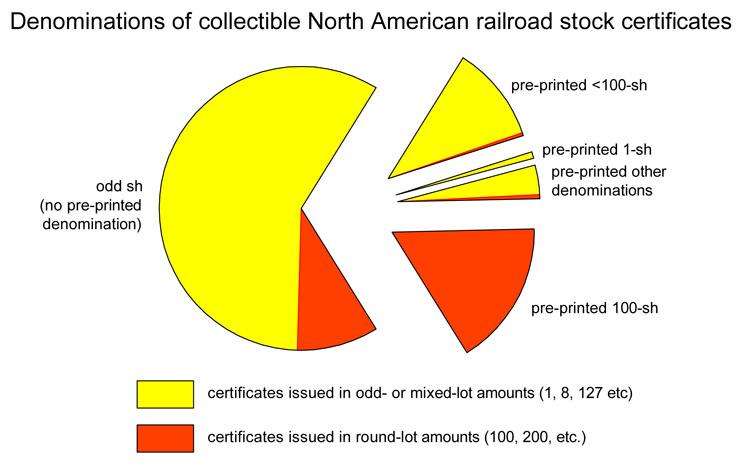
In gross terms, round lots (any increment of 100 shares) represent about 26% of all certificates I currently have recorded in the database. Obviously, investors have always been able to buy stock certificates in any denomination that suited them. It turns out that the most popular single denomination was 100 shares (24%) with the second most popular being 1 share (14%).
The lion's share of collectible certificates currently reported are what I call odd-share certificates. 68% of all collectible certificates currently recorded are certificates with no pre-printed denomination. Such certificates usually have a simple line or a blank spot meant to be filled in with the number of shares being purchased.
The second most populous category is pre-printed 100-share certificates (17%) followed closely by pre-printed less than 100 share certificates (11%).
Companies issued certificates with other pre-printed denominations, but none were very popular. One-share certificates were popular in Mexico, but relatively few have been recorded from U.S. companies. A few companies tried other odd-lot denominations such as 10-, 25- and 50-shares, but not a tremendous number survive. Very few companies pre-printed large round-lot certificates such as 500- and 1000-shares.
The chart above shows the percentage of round-lot denominations that are currently known to appear on odd-share certificates and the four major groups of pre-printed certificates. As mentioned above, certificates denominated in round-lot amount account for about 26% of the collectible certificates in my database.
Both Hensley and I thought that the percentage of round lots should have been higher. Survivorship is certainly a great unknown. The current understanding is that round lot trades greatly outnumber odd lot trades in today's stock markets. Does that assumption extend far back into the past? Were round lots as popular in the past as they are supposed to be today?
The term "round lots" has been used for quite some time I can find the term in common use as far back as the 1850s in published discussions about shipments of iron, cotton, tin and other commodities. I can find reference to "round lot" stock trades (sometimes also known as "even lots" and "board lots") as early as 1930. However, Henry Clews never mentioned the term in his 1887 book Twenty-Eight Years on Wall Street. It is also curious that Haight & Freese, the famous Boston "bucket shop" operator, never mentioned "round lots" in any of its series of Guide to Investors from 1894 to about 1904. Merriam Webster's Collegiate Dictionary estimates the term was used as early as 1902, so I defer to its robust etymological research.
I suspect the earliest certificates with a pre-printed 100-share denomination appeared around 1868 or 1869. The earliest examples in the database are certificates from the Milwaukee & St Paul Railway and the New York Central & Hudson River Railroad, both dated 1870.
While I suspect that less than 100 share certificates probably appeared at the same time as the earliest 100-shares, the earliest surviving <100-share examples date from 1872 (from the International Railroad and other companies.)
Up until the time that 100-share certificates first appeared, round-lot trades accounted for about 10% of the certificates in the database. I have absolutely no way of knowing whether that number represents the percentage of all trades before 1870 or not. By the end of the 1870s, surviving round-lot certificates had grown to represent 19% of the trades (according to surviving certificates.)
After noticing the growth in round-lot certificates, I queried the database to give me round-lot and odd-lot certificates by decade from the earliest to the latest.
The chart below shows how the percentage of round-lots (in red) have trended through time. It is readily appearent that the percentage of round-lots increased substantially in the last four decades. Unfortunately, because of my own time constraints, I rarely record recent certificates because they are normally priced far below my $20 cutoff. Consequently, readers must understand that the database is skewed toward earlier certificates.
Regardless of the accuracy of the count of recent certificates, the chart definitely shows a justification for 100-share certificates appearing when they did. The chart also illustrates how strongly odd-lot trades have persisted, very much counter to prevailing wisdom.
One final note.
I also checked whether there was a propensity for celebrity autographs to be associated with round-lot trades. There IS a relationship, but it is very tricky to draw conclusions. First, the number of survivng samples is relatively low. Second, many celebrity autographs (Gould, Dix, Durant, Sage, Devereux, Forbes, William K. Vanderbilt and Cornelius Vanderbilt II come to mind) appear on stock certificates in the roles of corporate officers as opposed to stockholders. If I limit the search to simply stock ownership, celebrity autographs appear on round-lot certificates with a little greater frequency, but it's insignificant. We must remember that the biggest stock operators in history (Gould, Harriman, Vanderbilt, Little, Sage, Mellen, Roberts, Morgan et al.) purposely hid their ownership behind squadrons of intermediary brokers.
So, yes, I most assuredly believe that there is a very strong relationship between round-lot trades and millionaires. It's just not provable.
Subscribe to:
Comments (Atom)